
Warehousing, Logistics & JIT Integration
Part of SGH Technical Resource Centre
Injection moulding supply and performance does not end at the moulding machine. SGH supports structured warehousing, kitting and structured delivery programmes aligned with customer JIT and Kanban systems. Our approach reduces supply chain friction and improves overall equipment efficiency for our clients and are essential to maintaining continuity within UK and international supply chains.. This guide explains how we integrate production with logistics and stock management.
Explore related content:
Manufacturing Does Not End at the Press
Injection moulding performance is only part of supply chain reliability. Delivery stability depends equally on warehousing, stockholding discipline and structured logistics integration.
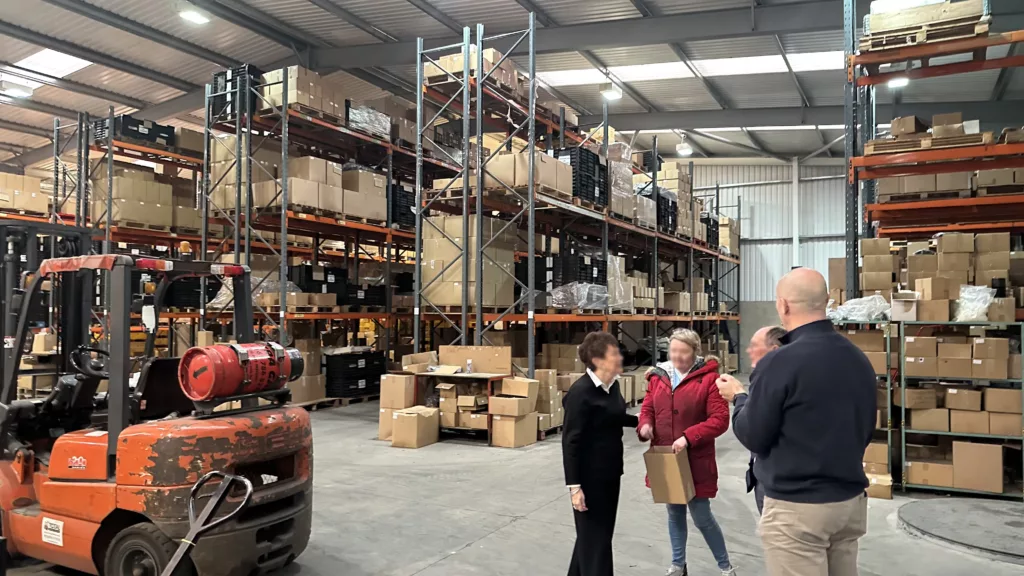
At SGH, production and logistics are managed as a unified system. Alongside our 25-press moulding operation, we operate 10,000 sq ft of dedicated finished goods warehouse space to support structured stockholding and delivery programmes.
This integration enables us to support JIT, Kanban and safety stock models without compromising dimensional control or production efficiency.
Structured Stockholding for Injection Moulding Supply
Low volume, high mix manufacturing requires intelligent inventory planning.
At SGH, we support:
- 6–12 week safety stock programmes
- Agreed minimum stock levels
- Scheduled replenishment cycles
- Customer-specific stock agreements
This protects continuity of supply while maintaining lean manufacturing principles.
Stockholding is aligned to validated batch performance to ensure dimensional consistency across shipments.
What Is Just-In-Time (JIT) in Injection Moulding?
Just-in-time (JIT) supply in injection moulding refers to delivering components in line with production schedules rather than holding excess inventory at the customer site. Structured stockholding, forecast alignment and controlled release programmes allow batch sizes to be optimised while maintaining availability. At SGH, JIT integration is supported by traceability, warehousing coordination and high-mix production planning.
Just-In-Time (JIT) Integration
For customers operating lean production systems, JIT delivery reduces inventory burden but increases reliance on supplier stability.
SGH supports JIT integration through:
- Structured production scheduling
- Advance capacity planning
- Controlled batch release procedures
- Transparent delivery performance monitoring
Kanban system integration, completing October 2026, will further enhance planning coordination.
Delivery performance is not left to chance; it is engineered into the production schedule.
High-Mix Production and Logistics Coordination
With approximately 1,000 active SKUs annually, logistics coordination must match manufacturing complexity.
Frequent production runs across varied SKUs require:
- Accurate stock records
- Clear batch traceability
- Controlled picking and dispatch procedures
- Defined reorder triggers
Our planning systems coordinate press utilisation, tool lifecycle scheduling and stockholding commitments to avoid instability.
International Shipping Capability
SGH currently supports shipping to 13 countries.
Export integration includes:
- Structured packaging protocols
- Batch traceability documentation
- Compliance alignment where required
- Coordinated dispatch scheduling
International supply increases the importance of dimensional stability and validation discipline, as rework or recall risk is magnified once components leave the UK.
Batch Traceability in Injection Moulding Logistics
Dimensional stability must be preserved through to dispatch.
Each production batch undergoes inspection prior to release. Batch traceability is maintained and will transition to barcode-driven Insight123 integration by March 2026.
From H2 2026, the SGH Client Portal will provide:
- Batch-level QC documentation
- Tool service history
- Delivery performance visibility
- Scope 3 emissions calculations linked to production data
This transparency supports both operational and ESG reporting requirements.
Supporting Own-Brand and Acquired Product Lines
As part of our bolt-on acquisition programme, SGH currently owns and produces 18 proprietary SKUs supplied directly to market.
Operating as both manufacturer and product owner strengthens our understanding of:
- Inventory exposure
- Market demand fluctuation
- Stock obsolescence risk
- Lead time sensitivity
This experience informs how we structure external customer stockholding programmes.
Warehousing and Tool Lifecycle Coordination
Stockholding strategy must align with tool lifecycle planning.
High-runner components may justify extended stockholding, while lower-volume components require tighter cycle coordination to avoid excess inventory.
Tool servicing intervals are aligned with production frequency:
- Under 50,000 cycles annually – annual servicing
- Over 50,000 cycles annually – six-monthly servicing
- Over 100,000 cycles annually – quarterly inspection
This ensures that stock replenishment cycles are not disrupted by preventable tooling downtime.
Energy Efficiency and Logistics Stability
Energy efficiency improvements also support logistics reliability.
Through CAPEX investment, SGH has achieved a 9% electrical efficiency improvement, with a further 20% reduction targeted over five years. Our 100 kWp solar installation reduces peak demand exposure.
Energy stability contributes to consistent production scheduling, reducing the risk of disruption in JIT supply models.
Protecting Delivery Performance
Controlled warehousing and forecast-based production planning reduce supply disruption risk and support long-term customer continuity. Reliable delivery requires integration across:
- DFM
- Tool validation
- Preventative servicing
- Production scheduling
- Warehouse management
At SGH, these functions are not siloed. They operate within a coordinated system supported by Insight123 and future client-facing digital visibility.
This integrated model protects both dimensional consistency and on-time delivery.
If your programme requires JIT delivery, structured stockholding or international coordination, we can align production and logistics to protect supply continuity and cost control.