
Injection Moulding Process
Part of SGH Technical Resource Centre
As a UK injection moulding manufacturer, SGH integrates tool design, material science and production planning within a structured and ISO-governed environment.
At SGH, injection moulding is not simply a production method; it is an engineered process that integrates tool design, polymer behaviour, machine capability and long-term supply stability. With over four decades of UK-based manufacturing experience, we manage the full moulding cycle in-house, from initial tooling validation through to serial production and assembly. This guide explains how injection moulding works in practice and how we apply it within our own facilities.
Explore related content:
What Is Injection Moulding?
Injection moulding is a repeatable manufacturing process used to produce precision plastic components by injecting molten polymer into a hardened steel mould tool. While the principle is straightforward, reliable production depends on disciplined control of material preparation, tooling accuracy, machine capability and ongoing maintenance.
At SGH, injection moulding is managed as a fully integrated system. In FY26 alone, we produced 3,583,000 components across approximately 1,000 active SKUs, ranging from low-volume technical parts to high-runner production components. This scale, combined with our in-house toolroom and validation capability, allows us to support complex manufacturing programmes with long-term stability.
How the Injection Moulding Cycle Works
Material Preparation
Polymers are supplied in pellet form and must be correctly dried and conditioned prior to processing. Materials such as nylon are hygroscopic and require controlled drying to prevent dimensional instability or cosmetic defects.
At SGH, material preparation protocols are defined at the DFM and validation stage. We process a broad range of polymers including:
- Nylon (including 15–30% glass-filled and UV-stable grades)
- Polypropylene (including flame retardant, talc-filled and glass reinforced variants)
- ABS (including UV-stable and glass-filled grades)
- Acetal
- Acrylic
- HDPE and LDPE
- Polycarbonate and PC-ABS
- TPE and TPU
- EPDM
- PBT, Polystyrene and HIPS
Material traceability is fully batch controlled, with deeper barcode integration being implemented through Insight123 in 2026.
Injection Phase
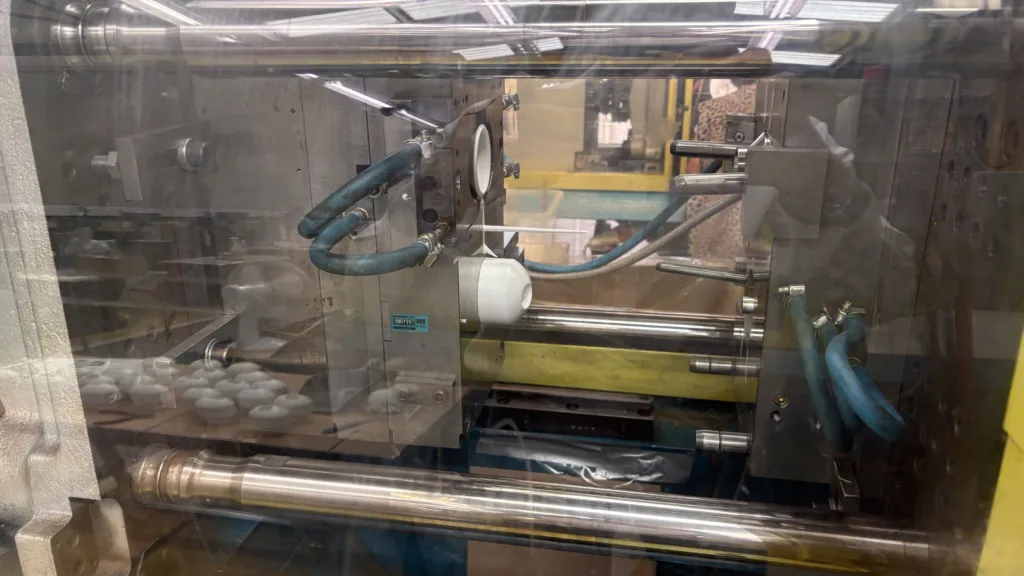
The prepared material is heated to a molten state and injected into the mould cavity under pressure. Injection speed, pressure profile and holding pressure must be matched precisely to material characteristics and part geometry.
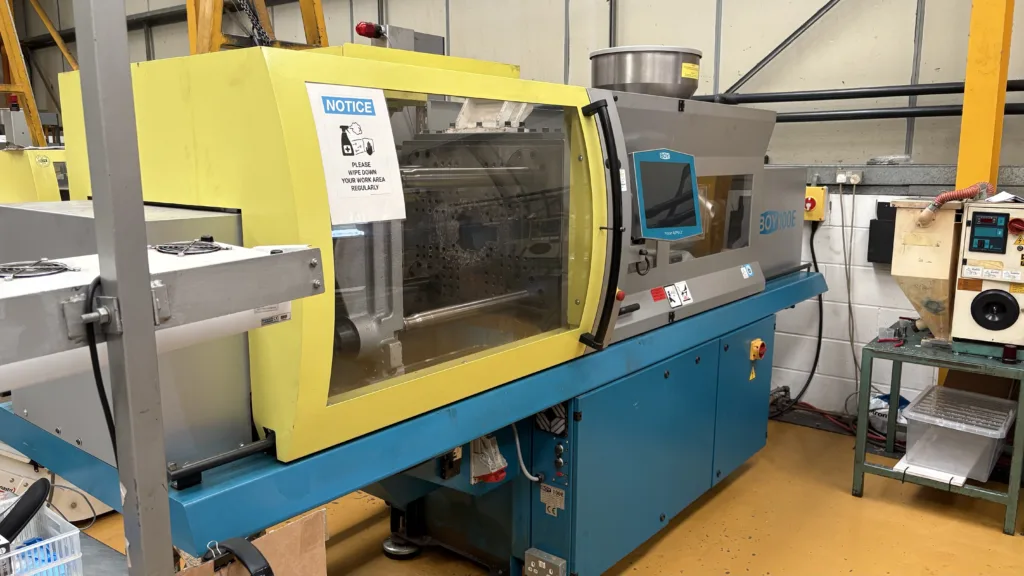
SGH operates 25 injection moulding machines ranging from 22T to 650T clamping force. Our fleet includes:
- 1 × 650T Haitian (electric)
- 2 × 350T Billion (electric)
- Multiple Boy, Borche and Billion presses across 22T–260T (hydraulic and electric mix)
- A 6-cell 22T Manumould cell transitioning to Babyplast Mini automation from summer 2026
This range enables us to match machine selection precisely to part size and shot weight, improving both efficiency and energy control.
Cooling and Solidification
Cooling is typically the longest part of the cycle and is governed by tool design and material thermal properties. Cooling channel design, mould steel selection and cycle optimisation directly influence repeatability and energy consumption.
Electric presses, such as our 650T Haitian and 350T Billion machines, provide improved energy efficiency and process stability. Combined with our broader CAPEX programme, we have already achieved a 9% electrical efficiency improvement, with a further 20% improvement targeted over five years. Our 100 kWp solar installation contributes an additional measurable reduction in peak consumption.
Ejection and Cycle Control
Once solidified, the component is ejected and the cycle repeats. Cycle time stability is critical in both high-runner and low-volume environments.
At SGH, cycle parameters are validated during controlled tool trials prior to serial release. This ensures that production performance aligns with dimensional and cosmetic requirements before full-scale manufacturing begins.
Machine Capability Within Our UK Injection Moulding Facility
Manufacturing across five sites in Greater Manchester, our machine range of 20T–650T allows us to support both micro components and larger structural parts. Shot weights vary from micro precision components through to large structural mouldings exceeding 3kg, depending on application and material. The presence of a dedicated low-tonnage cell is particularly important in a low-volume, high-mix environment.
Typical production characteristics:
- Low volume average batch size: c700 units
- Higher volume batch size: up to 24,000 units
- High-runner components account for c1,000,000 units annually
- Approximately 1,000 active SKUs per year
This diversity requires structured planning and tool management rather than reliance on single-SKU throughput.
From Tool Trial to Serial Production
Injection moulding performance is determined long before production begins.
At SGH:
- All tooling is designed in-house (with optional overseas partnership route where commercially appropriate)
- We provide structured DFM review prior to tool release
- Controlled trials are conducted prior to sign-off
- PPAP Level 3 and Level 5 elements are supported as required
Only c15% of tooling currently utilises our overseas partnership, and this is always a conscious, client-led decision. We provide full visibility of cost, validation impact and Scope 3 implications before proceeding.
Low Volume, High Mix Control
Many manufacturers are structured around high-volume repetition. SGH is deliberately structured to manage complexity.
With c1,000 SKUs annually and varied production frequencies, our planning systems and warehousing integration are critical.
We operate:
- 10,000 sq ft dedicated finished goods warehouse
- Structured 6–12 week safety stock programmes where required
- JIT supply integration
- Kanban system implementation completing October 2026
- Global shipping to 13 countries
This allows us to stabilise press utilisation while supporting lean customer models.
Dimensional Stability and Process Monitoring
Tolerance control in injection moulding is influenced by:
- Tool precision
- Material behaviour
- Machine repeatability
- Maintenance discipline
We utilise CMM inspection, manual and vision measurement systems (with on-line vision integration for high-runner clients from 2026). Full batch traceability is maintained, transitioning to barcode-driven Insight123 integration in March 2026.
Service frequency for tooling is aligned to production volume:
- <50,000 cycles annually: service annually
- 50,000 cycles annually: service every six months
- 100,000 cycles annually: service quarterly
All servicing is documented and recorded on internal tool cards, which will be accessible through the SGH Client Portal in H2 2026.
Integration with Assembly and Product Ownership
Injection moulding at SGH does not operate in isolation.
We provide:
- Class 8 cleanroom assembly (assembly only)
- Technical sub-assembly and kitting
- Support for medical device customers including DePuy and Oxylitre
- 18 SGH-owned SKUs as part of our bolt-on acquisition programme
Our own product portfolio reinforces our understanding of tooling lifecycle, cost stability and market expectations, as we are both manufacturer and brand owner.
Manufacturing Transparency and Future Visibility
Injection moulding data is increasingly important to customers.
Through Insight123 and the upcoming SGH Client Portal (H2 2026), clients will have visibility of:
- OTIF performance
- Batch-level QC documentation
- Tool service history
- Scope 3 emissions calculated using formula-based models driven by real cycle data
This level of transparency is uncommon within SME manufacturing but aligns with our long-term investment strategy under Jalex Futures ownership.
What an Injection Moulding Manufacturer Provides
As a UK injection moulding manufacturer, SGH Moulds delivers precision plastic components across a broad range of materials and applications from prototype to production. Our 25-press facility (20T–650T), structured tool validation process and DFM review ensure repeatable dimensional stability and quality on every programme. We combine lifecycle planning, preventative tooling maintenance and high-mix production capability to support regulated and industrial supply chains with reliable delivery performance.
To see how this capability is delivered in production, explore our Injection Moulding and Tooling Services.
If you are planning a new moulding project or reviewing an existing supply arrangement, our technical team can assess feasibility, material suitability and production strategy from the outset.